

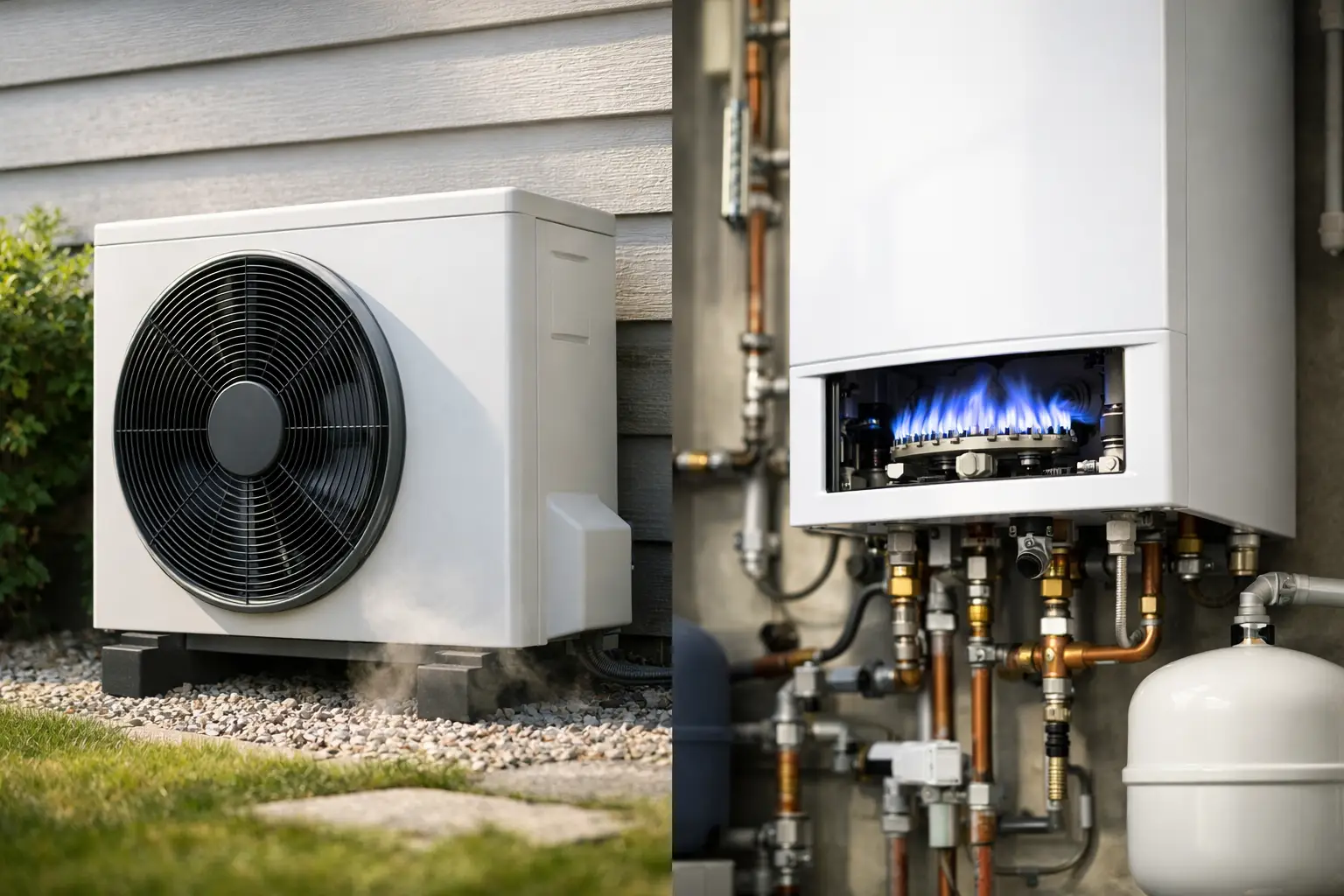
When your boiler is ageing, the question stops being theoretical very quickly. Heat pump vs gas boiler is really a decision about monthly costs, comfort, disruption, and how future-proof you want your property to be.
For many households, gas has been the default for years because it is familiar, relatively cheap to install, and works well with existing radiators. Heat pumps are different. They can be far more efficient, but they are not a straight like-for-like swap in every home. The right choice depends on your insulation, your budget, your heating habits, and how long you plan to stay in the property.
Heat pump vs gas boiler: the basic difference
A gas boiler burns fuel to create heat. That heat is then used for your radiators and hot water. It is a well-known system, and most homes with mains gas already have the pipework, controls, and heating setup in place.
A heat pump does not burn fuel. It moves heat from the outside air or the ground into your home. Because it transfers heat rather than generating it through combustion, it can deliver more heat energy than the electricity it uses. That is the main reason heat pumps are often described as highly efficient.
The trade-off is that they work best when the home is reasonably well insulated and the heating system is designed to run steadily at lower temperatures. That can mean some upgrades alongside the main installation.
Upfront cost is where the gap is biggest
If you are comparing quotes, the first difference you will notice is installation cost. Replacing an old gas boiler with a new gas boiler is usually the cheaper option, especially if you are keeping the same basic system and do not need major pipework changes.
A heat pump installation is usually more expensive at the start. The unit itself costs more, and some homes need larger radiators, a hot water cylinder, or insulation improvements to get the best results. In some cases, electrical work is needed too.
That does not automatically make a heat pump poor value. It means the financial case is longer term. You are comparing a lower upfront price for gas with the potential for lower running costs and lower carbon emissions from a heat pump over time.
For homeowners planning to stay put for years, that longer view matters. For landlords or anyone needing the lowest immediate spend, the boiler often looks simpler.
Running costs depend on the property, not just the technology
This is where many comparisons become too simplistic. A heat pump can be extremely efficient, but electricity costs more per unit than gas. Whether it saves money depends on how efficiently it runs in your home.
In a well-insulated property with suitable radiators or underfloor heating, a heat pump can compete very well. It tends to perform best when it maintains a steady indoor temperature rather than blasting heat on and off.
In an older, draughtier home with poor insulation, a gas boiler may still be cheaper to run in practice, at least until the building fabric is improved. That is why any honest recommendation should start with the property itself rather than broad claims.
If you already have or are considering solar panels, the balance can shift again. Using some of your own generated electricity can improve the economics of a heat pump, particularly during daylight hours. For households in South Wales and the South West looking at wider energy upgrades, this joined-up approach often makes more sense than viewing heating in isolation.
Efficiency and carbon are not the same as cost
A heat pump is usually the stronger option on efficiency. It can produce several units of heat for every unit of electricity it uses. A gas boiler, even a modern efficient one, cannot match that because it relies on combustion.
From an emissions point of view, heat pumps also have a clear long-term advantage as the electricity grid continues to get cleaner. If reducing your home’s carbon footprint is a major driver, a heat pump will generally come out ahead.
But people do not heat their homes with efficiency figures alone. They heat them with real budgets. So the better question is not which system is more efficient, but whether the more efficient system will perform well enough in your home to justify the higher starting cost.
Comfort feels different with each system
A boiler tends to give a more intense burst of heat. Many homeowners are used to turning the heating on for set periods and getting quick, high-temperature warmth through radiators.
A heat pump usually delivers gentler, steadier heat over longer periods. That can actually feel more comfortable once you are used to it, because rooms stay more consistent instead of swinging from too cold to too warm. Still, it is a change in how the home is heated.
This matters if your household prefers fast temperature boosts or has a routine built around short heating windows. A heat pump can do the job well, but it is most effective when the system is designed properly and used in the way it was intended.
Hot water and space requirements
Gas boilers are compact. Combination boilers in particular suit homes where space is tight, because they do not usually need a separate hot water cylinder.
Heat pumps often need more room. Many systems use a cylinder for stored hot water, and the outdoor unit needs a suitable place with good airflow. For some properties, especially smaller homes or flats, that practical issue can be just as important as the cost comparison.
That said, space constraints do not always rule out a heat pump. They simply mean the design work needs to be done carefully. This is one reason installer quality matters so much. A good survey will highlight any layout issues before you commit.
Installation disruption and maintenance
A straightforward boiler replacement is usually faster and less disruptive. If the existing setup is serviceable, the installer can often swap the unit with minimal changes elsewhere.
A heat pump installation can take longer, especially if radiators, cylinder space, or insulation upgrades are involved. There is more planning, and the design side is more important.
Maintenance is a more balanced picture. Boilers need regular servicing and involve combustion components, flues, and gas safety checks. Heat pumps also need servicing, but they do not burn fuel on site. Neither system should be treated as fit-and-forget. The difference is that poor heat pump design causes frustration faster than poor boiler design, because system matching is so important.
So which is better for your home?
If your priority is the lowest upfront cost, minimal disruption, and a familiar heating setup, a gas boiler is often the practical choice. That is especially true if your home already uses gas, your radiators are sized for high-temperature heating, and you are not planning wider efficiency upgrades.
If your priority is lower carbon heating, long-term efficiency, and better alignment with future energy prices and regulations, a heat pump deserves serious consideration. It becomes even more attractive if your property is well insulated or you are already improving it.
There is also a middle ground. Some homeowners first improve insulation and then replace the heating system later. Others combine a heat pump with solar and battery storage to reduce electricity import and improve savings. The best route is often a staged one rather than an all-at-once upgrade.
What to check before asking for quotes
Before making a decision, focus on a few practical questions. How well insulated is your home? Are your current radiators suitable for lower-temperature heating? Do you have space for a cylinder and outdoor unit? Are you planning to stay in the property long enough to see the return from a larger upfront investment?
Just as importantly, compare installers as carefully as you compare technologies. A poor recommendation can make either option look worse than it really is. For households in places such as Cardiff, Newport or Bristol, local knowledge can help because housing stock varies so much from area to area. A Victorian terrace, a newer estate home, and a rural off-grid property will not all suit the same answer.
If you are weighing up heat pump vs gas boiler, the smartest move is not to chase the cheapest quote or the boldest claim. It is to get clear advice based on your actual property, your budget, and how you want your home to feel day to day. That is usually where the right decision becomes much easier.

