

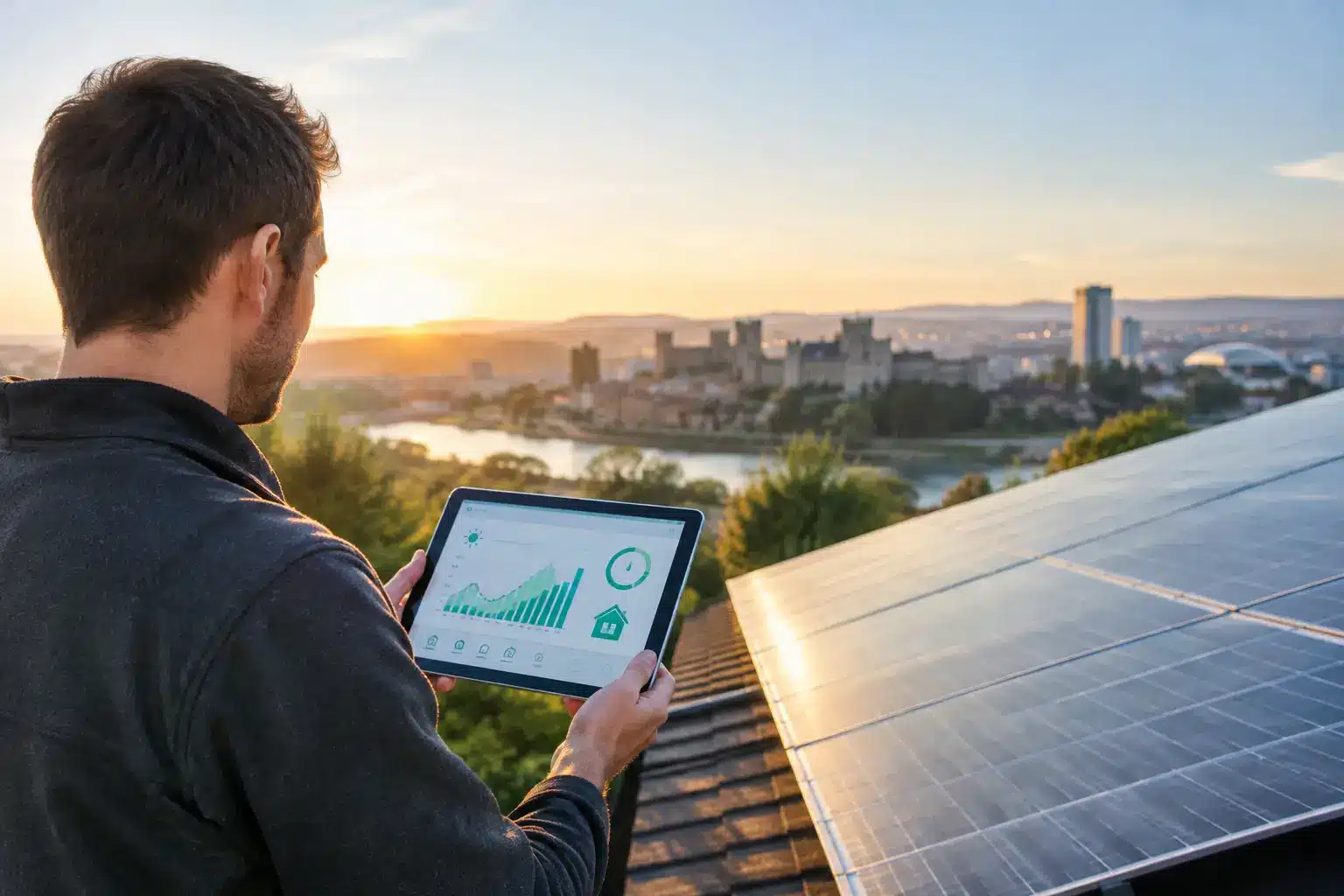
A bright Cardiff morning can make your solar app look very encouraging. But the figure that matters is not simply how much electricity your panels generated. It is whether that generation matched the weather, whether your home used it at the right time, and whether a sudden change points to a fault. This Cardiff solar monitoring guide explains how to read the useful numbers without getting lost in technical data.
For most households and businesses, monitoring should provide reassurance rather than another daily chore. A quick check every few days, plus a closer look at monthly trends, is usually enough to protect the value of your investment and identify when it is sensible to call an installer.
What solar monitoring actually tells you
Most modern solar systems include an inverter app or web portal. It collects data from the inverter, and sometimes from a separate smart meter or consumption clamp. What you can see depends on the equipment fitted, but the most useful systems show generation, household consumption, grid import, export and battery activity.
Generation is the electricity your panels produce. Consumption is the electricity your property uses. Import is electricity bought from the grid, while export is surplus solar sent out to the grid. If you have battery storage, the app should also show its state of charge and whether it is charging from solar, discharging to support the property, or charging from the grid under a tariff setting.
A generation-only app is still worthwhile, particularly for spotting a stopped inverter. However, it cannot tell you how much solar electricity you used yourself. That distinction matters because using power as it is produced usually saves more than exporting it, although the exact value depends on your electricity tariff and export payment.
Cardiff solar monitoring guide: the figures to check
Do not judge your system against one unusually sunny or overcast day. Cardiff weather is changeable, and cloud cover can reduce output quickly even when it does not feel particularly dark outside. Instead, compare similar days and, more importantly, compare the same month year on year.
Start with daily generation. Your app may show this in kilowatt-hours, written as kWh. A 4 kWp system will not produce 4 kWh every hour. The kWp figure is its maximum rated capacity under controlled test conditions, not a promise of constant output. Panel direction, shading, temperature and the season all affect the result.
Next, look at the production curve if your app provides one. On a clear day, output should generally rise through the morning, peak around the middle of the day and taper off towards evening. A sharp, unexpected drop in the middle of a bright day can be worth investigating. It may be temporary shading from a chimney, tree or heavy cloud, but a repeated pattern may suggest an issue with a panel string, optimiser or inverter.
Then check self-consumption. This is the portion of solar generation used on site rather than exported. A low percentage does not mean your system is performing badly. It often means your household is out during sunny hours or that your business uses more electricity in the evening. It is a prompt to move flexible demand where practical, not a reason to chase an unrealistic target.
Finally, if you have a battery, review how much solar energy it stores and how much grid electricity you still import after sunset. A battery can increase solar self-use, but its benefit depends on its capacity, your evening consumption and your tariff. Monitoring helps you see whether its settings suit how you actually use electricity.
What normal seasonal changes look like
Solar output in South Wales naturally varies a great deal over the year. Long summer days can produce several times more electricity than short winter days, even with the same panel array. A quiet January is not evidence that your installation has failed.
Rain is not automatically bad for production either. Panels generate from daylight, not heat, and cool bright conditions can be productive. Rain can also wash away loose dust and pollen. The concern is not a few lower-output days. It is a sustained reduction compared with similar weather and the same season in a previous year.
It is also normal for generation to fall gradually over the life of a system. Solar panels degrade slowly, typically by a small amount each year. A sudden, substantial change is more meaningful than a gentle long-term trend.
How to use monitoring to cut electricity costs
The clearest saving usually comes from matching electricity use to solar generation. Appliances that use significant power, such as washing machines, dishwashers, immersion heaters and EV chargers, are good candidates for daytime use when safe and convenient. Timers, smart plugs and charger schedules can help, but keep the setup simple enough that you will actually use it.
For example, a household that runs an EV charger overnight on a low-rate tariff may still be making the right choice. Cheap off-peak electricity can sometimes cost less than the value of saving daytime solar for other uses or exporting it. Your monitoring data and tariff rates should guide the decision rather than a blanket rule that solar electricity must always be used immediately.
Battery owners should check that charging and discharging schedules reflect their tariff. Some systems can charge cheaply overnight and preserve solar capacity for the following day, while others are set to prioritise solar charging. Neither approach is always best. It depends on export rates, off-peak prices, expected sunshine and how much electricity the property needs after dark.
Commercial properties may find that monitoring confirms a strong fit between daytime operations and solar generation. Offices, workshops and retail premises with reliable daytime demand can use a high share of their generation directly. If output is regularly exported while the site still imports power at other times, an installer can advise whether battery storage, load scheduling or a revised system configuration would help.
Warning signs that deserve attention
Check your monitoring platform after installation, then get into the habit of reviewing it periodically. Contact your installer or a qualified solar maintenance specialist if you see any of the following for more than a brief period:
- The inverter shows a fault code, warning light or no generation during daylight.
- Production is consistently far below comparable periods without an obvious weather explanation.
- One section of the array performs noticeably worse than the rest where panel-level monitoring is available.
- Battery charge levels, grid imports or exports look implausible compared with normal household activity.
- The app has stopped reporting, particularly if the inverter itself also appears offline.
An app connection problem is not always a generation problem. Wi-Fi changes, router replacements and mobile signal issues can interrupt reporting while the solar system continues to work normally. Check the inverter display and your consumer unit before assuming the panels are at fault. Never remove electrical covers or attempt inverter repairs yourself.
Keep the data useful, not overwhelming
Set a realistic routine. A weekly glance can confirm that the system is live and broadly behaving as expected. At the end of each month, compare generation, import and export with the previous month and with the same month last year. Keep a note of anything that affected performance, such as scaffolding, building work, prolonged snow or new tree growth.
Annual monitoring is a good time to consider a professional health check, especially for older systems or properties with changing shade patterns. This can include visual inspection, inverter checks and testing where appropriate. It also gives you an opportunity to review whether battery storage, EV charging or tariff changes could improve the return from your existing panels.
If you need repairs, maintenance or advice on improving an underperforming system, Solar Planet can help you compare trusted MCS-accredited local installers without the work of researching each provider yourself. The right professional will assess the evidence behind the app figures rather than guessing from a screenshot.
Your solar monitoring should make ownership feel clearer, not more complicated. Focus on patterns, use the information to shift a few flexible tasks, and act early when a meaningful change persists. That simple approach helps every sunny spell work harder for your property.

