

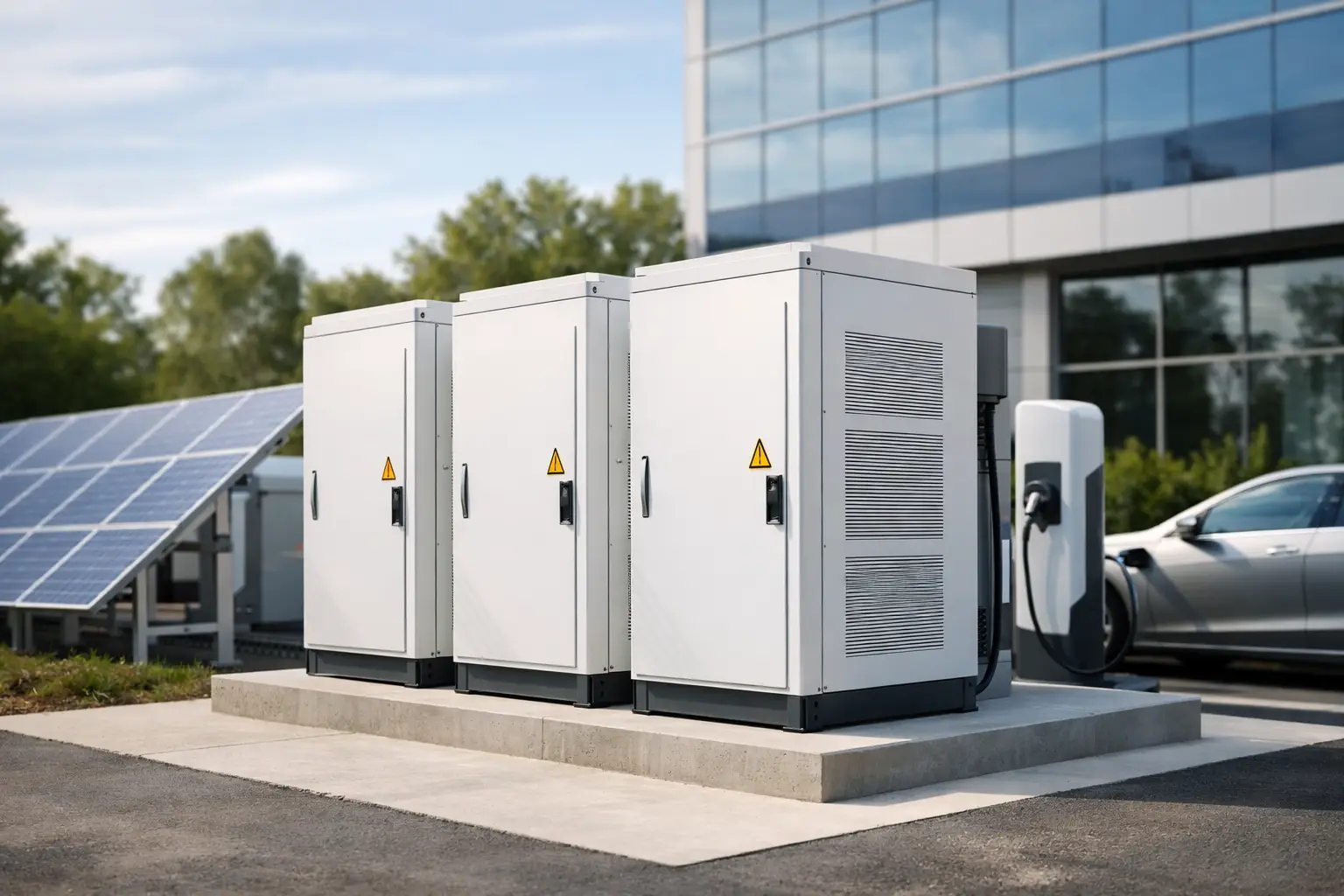
A business that generates solar electricity at midday but buys costly power during the late afternoon has a clear opportunity to improve how it uses energy. The most valuable commercial battery storage benefits come from shifting electricity to the moments when it is needed most, rather than simply generating more of it.
For businesses across South Wales and the Bristol area, a battery can turn a solar installation from a daytime saving into a more flexible energy asset. It will not suit every site in the same way, however. The right system depends on when your premises use power, your electricity tariff, available solar generation and whether continuity of supply matters to your operation.
How commercial battery storage reduces energy costs
Commercial batteries store electricity for later use. They can charge from surplus solar generation, from the grid when prices are lower, or from a combination of both. The stored electricity can then support the building when demand rises or grid electricity is more expensive.
For many organisations, the first saving comes from increasing solar self-consumption. Without a battery, a shop, office, warehouse or workshop may export excess solar electricity in the middle of the day, then import power after staff, equipment and lighting loads increase. A battery retains more of that generation for use on site.
This matters because the value of electricity avoided is often greater than the value received for electricity exported. The exact difference varies by supply contract and export arrangement, so a projected saving should always be based on real half-hourly consumption data where possible, rather than a generic estimate.
Batteries can also reduce exposure to expensive periods on time-of-use tariffs. If your tariff charges more at particular times, a well-programmed battery may charge when rates are favourable and discharge during higher-cost periods. This approach is sometimes called energy arbitrage, but the practical question is simple: can the battery reliably avoid buying electricity when your business would otherwise pay the most?
Managing short, costly demand peaks
A brief spike in demand can have an outsized effect on some commercial bills. This may happen when machinery starts simultaneously, EV chargers are in use, refrigeration cycles overlap or a kitchen enters its busiest service period.
Battery storage can supply part of that shortfall, reducing the power drawn from the grid at the peak. Known as peak shaving, this can be particularly useful for sites with high, uneven demand. The potential benefit depends on how your network and supply charges are structured, so an installer or energy adviser should assess the bill as well as the building’s consumption profile.
Better use of solar power on site
Solar panels and batteries work well together because their natural patterns are different. Solar generation is strongest during daylight hours, while many businesses need substantial electricity early in the morning, in the evening or during cloudy periods when generation falls.
A battery helps bridge that gap. A café may store solar energy before its evening rush. A small manufacturer may use stored energy as production continues beyond peak sunlight. An office can retain some of its daytime generation to cover late-afternoon air conditioning, IT equipment and lighting.
This does not mean a battery makes a property fully energy independent. Winter generation is lower, and a battery has a finite capacity and output. Yet it can reduce routine grid imports and make the solar system deliver more value across the working day.
The best battery size is not automatically the largest one available. An oversized unit that sits partly unused can lengthen payback, while an undersized one may fill too quickly or lack enough discharge power to help at key times. Good design starts with usage data, expected solar output and the operational hours that matter to your business.
Commercial battery storage benefits beyond the bill
Lower electricity costs are usually the main reason to consider storage, but they are not the only one. A battery can give a business greater control over energy use and more certainty when prices are difficult to predict.
For organisations reporting on carbon reduction, using more on-site renewable electricity can support practical sustainability targets. It can also provide a clear story for customers, employees and stakeholders: the business is making fuller use of the clean electricity it generates rather than relying solely on grid imports.
There can also be value in preparing for change. A site planning to add EV charging, electric heating, refrigeration, expanded production or additional office space may find that a battery helps manage the new load. It is not a substitute for checking electrical capacity, but it can form part of a sensible wider energy plan.
Backup power needs careful planning
One of the most misunderstood benefits is backup power. Not every commercial battery will keep a building running during a power cut. Many standard systems shut down with the grid for safety reasons unless they have dedicated backup capability, appropriate switchgear and a properly designed critical-load circuit.
Where resilience is essential, the battery can be configured to support selected loads such as servers, alarms, emergency lighting, tills, refrigeration controls or communications equipment. Running an entire commercial premises during an extended outage requires far more capacity and must be assessed realistically.
For a business where even a short interruption is costly, it is worth discussing backup requirements at the start. That ensures the proposed system is designed for the loads that genuinely need protection, rather than assuming every battery offers the same level of cover.
What affects the return on investment?
Commercial battery storage is a site-specific investment. The strongest cases tend to combine meaningful daytime solar surplus, high electricity costs at certain times, predictable demand peaks and a building that will remain in use for years.
Your return will be influenced by the battery’s usable capacity, power rating, warranty, expected cycling, installation costs and future tariff changes. A battery with plenty of capacity but insufficient power may not manage a sharp demand peak. Conversely, a high-power system may be unnecessary for a site with steady, modest consumption.
Grid connection requirements can affect both cost and timing. Depending on the system and how it will operate, approval from the local Distribution Network Operator may be needed. This is a normal part of commercial project planning, but it should be handled before installation rather than treated as an afterthought.
It is also sensible to ask how the battery will be monitored and controlled. Clear reporting helps you see when it is charging and discharging, how much solar energy is being retained and whether the system is delivering the expected benefit. Ongoing support matters, particularly when tariffs or business operations change.
Questions to ask before choosing an installer
A useful proposal should explain the assumptions behind its savings estimate. Ask whether it is based on your actual interval data, how it accounts for seasonal solar output and whether it considers your current tariff and demand profile.
You should also ask what is included: electrical works, monitoring, grid application support, commissioning, warranties and any future maintenance requirements. If you need backup power, confirm exactly which circuits will remain live and for how long under realistic conditions.
For solar-connected projects, working with experienced, appropriately accredited professionals gives you more confidence that the battery, inverter and existing electrical system will be designed as one solution. Comparing several detailed quotes can make differences in equipment, warranty terms and system design easier to spot.
Solar Planet can help commercial decision-makers compare proposals from trusted local installers, without the time-consuming task of approaching each provider separately. The aim is not to push the biggest battery, but to find a system that fits the way your business actually uses electricity.
A well-sized commercial battery should earn its place every working day: storing more of your solar power, cushioning costly peaks and giving you better control over an energy bill that rarely stands still.

