

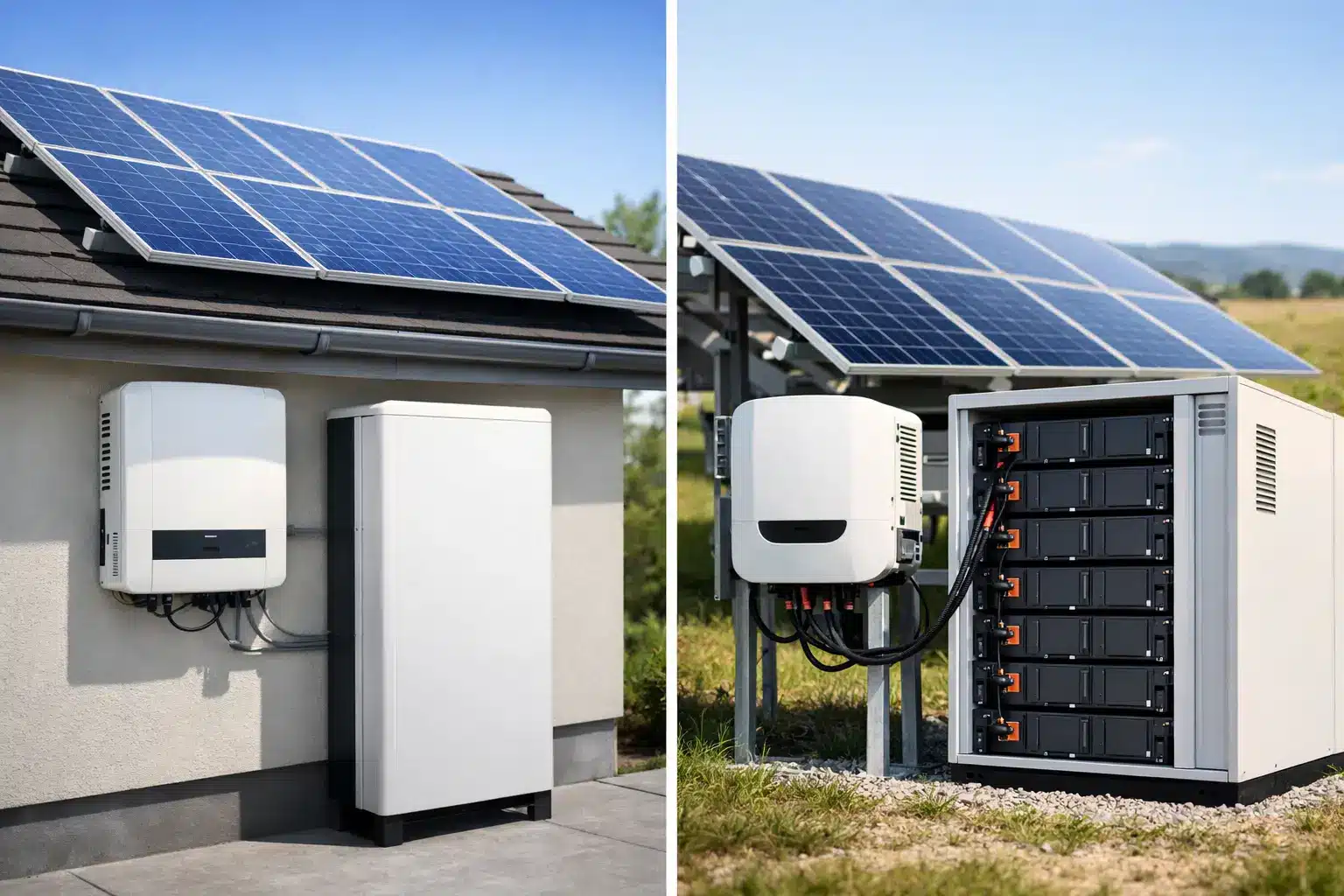
A battery can make your solar panels work harder for you, storing surplus daytime generation for the evening rather than exporting it to the grid. But the choice between an AC coupled vs DC coupled battery affects how the system is designed, its efficiency, upfront cost and how easily it can be added to an existing installation.
For many homeowners and businesses, this is not a choice to make in isolation. The right answer depends on whether you already have solar, the inverter on your property, your electricity-use pattern and whether backup power matters to you. Here is what the terms mean in practical terms.
What is an AC coupled battery?
An AC coupled battery has its own battery inverter. Your solar panels generate direct current, or DC, which your existing solar inverter converts into alternating current, or AC, for use in the property. The battery system connects on the AC side of that setup, usually through its own inverter.
When your panels produce more electricity than your home or business needs, the AC coupled battery takes that surplus AC electricity and converts it back into DC for storage. When you need power later, it converts the stored DC back to AC to run your appliances.
That may sound like extra work, and it is. Each conversion loses a small amount of energy. However, an AC coupled battery is often the straightforward choice for a property that already has a working solar PV system. It can usually be added without replacing the existing solar inverter, which can keep a retrofit simpler and less disruptive.
When AC coupling tends to suit a property
AC coupling is particularly attractive when your solar panels were installed a few years ago and their inverter still has plenty of life left. Instead of removing equipment that is doing its job, an installer can assess whether a compatible AC battery can be installed alongside it.
It can also work well where a battery is being considered before solar panels, as the battery operates independently from a PV inverter. That flexibility can be useful, though the system should still be sized around realistic consumption and future solar plans rather than simply choosing the largest battery available.
What is a DC coupled battery?
A DC coupled battery connects on the DC side of the system, before electricity is converted for use in the building. In most domestic installations, the solar panels and battery connect to a hybrid inverter that manages both.
Surplus electricity from the panels can travel directly into the battery as DC. Later, the hybrid inverter converts it to AC once, when you use it in the property. Fewer conversion stages usually mean better round-trip efficiency, so more of the solar electricity you generate is available to use later.
A DC coupled battery is therefore often a strong option for a brand-new solar and storage installation. The system can be planned as one coordinated design, with the inverter, panel array and battery capacity selected to work together from day one.
The limitation of DC coupling
The main trade-off is retrofit complexity. If you already have a conventional string inverter, moving to DC-coupled storage may mean replacing it with a hybrid inverter or making more substantial changes to the installation. That can be worthwhile in some cases, especially if the existing inverter is near the end of its expected lifespan, but it is not automatically the best-value route.
There are also compatibility considerations. The inverter needs the correct inputs, voltage range and power rating for the panels and battery. This is why a proper site survey matters more than a headline battery price.
AC coupled vs DC coupled battery: the key differences
The most meaningful difference is where the battery sits within the electrical system. An AC coupled battery stores electricity after it has already passed through the solar inverter. A DC coupled battery stores solar electricity before that main DC-to-AC conversion.
That design difference affects efficiency. DC coupling often captures slightly more of the solar energy sent to the battery, while AC coupling has additional conversion losses. In real life, though, the gap in household savings may be smaller than people expect. Your tariff, battery size, level of daytime demand and how much surplus solar you actually produce can have a far greater effect on financial returns.
Installation cost is also not as simple as saying one is always cheaper. For a new system, a DC coupled setup can be cost-effective because one hybrid inverter handles solar and storage. For an existing PV system, AC coupling can avoid the cost and waste of replacing a good inverter.
Expansion is another consideration. Some AC battery systems make it relatively easy to add storage capacity later. Hybrid systems can also be expandable, but the practical limits vary by manufacturer and inverter model. If you expect to buy an EV, add a heat pump or increase your electricity use over the next few years, raise this during the design stage.
Does one option provide backup power?
Neither AC nor DC coupling automatically means your property will have electricity during a power cut. Most standard solar and battery systems switch off when the grid fails, which is a safety requirement to protect network engineers working on local lines.
Backup power needs specific equipment and design, such as an emergency power output, changeover equipment or a dedicated backup circuit. The available output also matters. A system that can keep the broadband router, lights, fridge and a few sockets running may not be designed to run an electric shower, induction hob and heat pump at the same time.
Some battery products are better suited to whole-home backup than others, but the answer is always system-specific. Be clear about what you want to keep running and for how long. An experienced installer can then explain what is realistic within your budget and electrical supply arrangements.
Choosing based on your starting point
If you are installing solar panels and a battery together, DC coupling deserves serious consideration. It can offer strong efficiency and a tidy, integrated system, particularly where most charging will come from surplus solar generation.
If you already have solar panels, AC coupling is frequently the sensible first option. It can preserve your existing inverter, reduce installation changes and still make a significant difference to how much of your own generation you use. A good installer should not recommend replacing functioning equipment without clearly showing why the extra cost benefits you.
For a commercial property, the decision can be more involved. Half-hourly consumption patterns, export arrangements, three-phase supply, demand charges and operating hours all affect the case for storage. A business that uses power heavily during the day may gain more from adding panels or improving energy efficiency before investing in a large battery. Conversely, a site with evening demand or a time-of-use tariff may have a stronger reason to store electricity.
Do not compare batteries on capacity alone
A 10 kWh battery does not automatically deliver the same result as another 10 kWh battery. Usable capacity, maximum charging and discharge power, warranty terms, expected cycle life and compatibility with your inverter all matter. So does where it will be installed, as batteries need a suitable location with appropriate clearances and temperature conditions.
It is also worth looking at the full system design. An undersized inverter may limit how much solar power can charge the battery on a bright day. An oversized battery may sit partly unused for much of the year. The best system is usually one that matches your typical surplus generation and evening use, while allowing for sensible future changes.
Questions to ask before accepting a quote
Ask whether the proposed battery is AC or DC coupled and why that approach suits your current setup. Request an estimate of expected self-consumption, not just a generic savings figure, and check whether the quoted price includes all electrical work, monitoring equipment and any required consumer-unit upgrades.
You should also ask about backup capability, even if it is not a priority now, because retrofitting it later may involve additional work. Finally, confirm that the installer is MCS-accredited where required and can provide clear warranties for the battery, inverter and workmanship.
A battery should make your solar investment more useful, not make the decision harder. Whether AC coupling or DC coupling is right for your property, comparing proposals from vetted local installers gives you a clearer view of the design, price and likely savings before you commit.

