

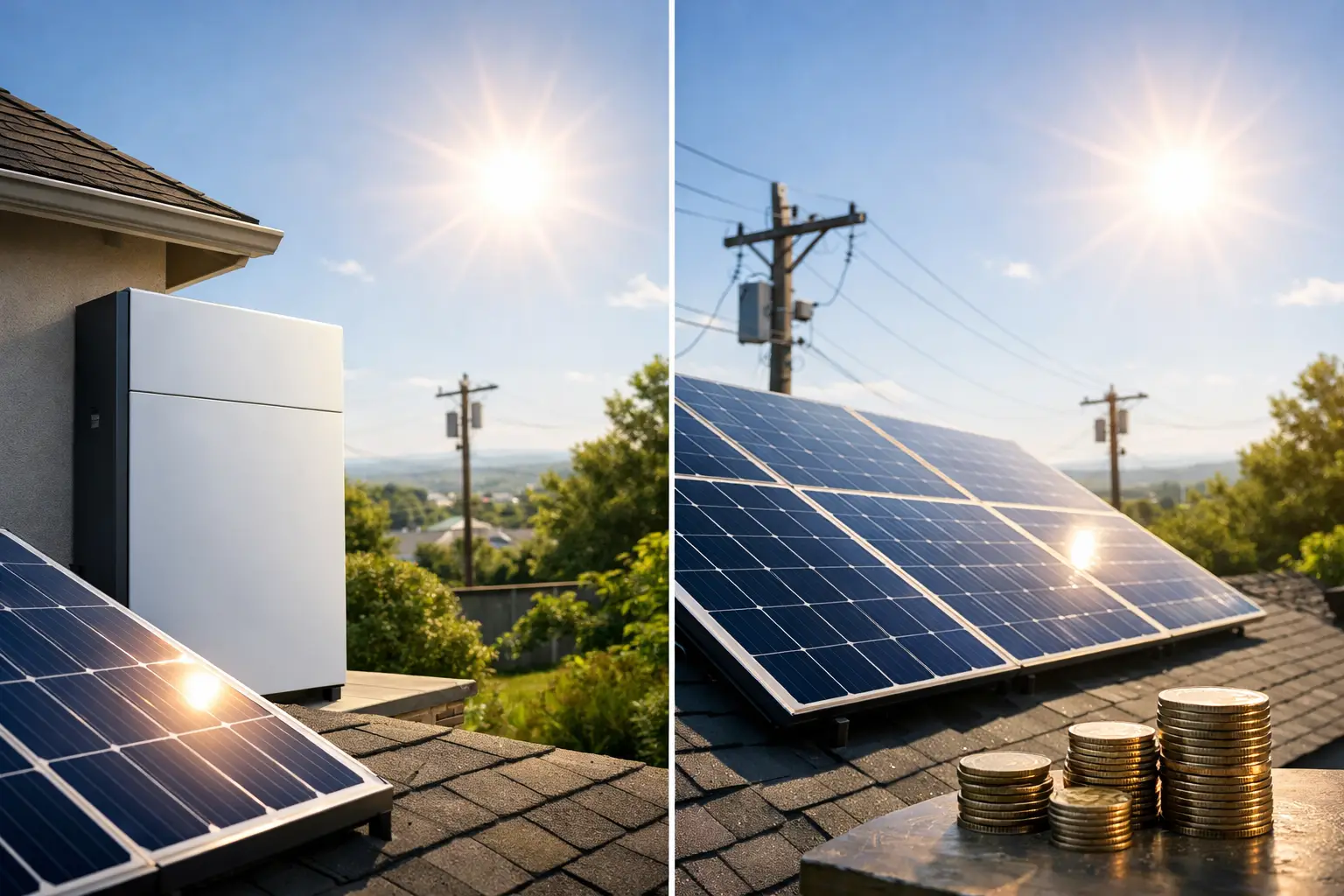
A solar battery vs no battery decision changes what your solar panels can do for you after the sun goes down. Panels without storage can still cut electricity bills significantly, particularly when a household or business uses plenty of power during daylight hours. Add a battery, however, and more of the electricity generated on your roof can be kept for the evening, rather than exported to the grid.
The better option is not automatically the one with the lowest upfront price. It is the system that reflects your energy use, budget, property and long-term plans. For many properties across South Wales and the Bristol area, a well-sized solar and battery system offers greater control over rising energy costs. For others, solar panels alone are the sensible first step.
Solar battery vs no battery: the key difference
Solar panels produce the most electricity around the middle of the day. Unfortunately, many homes need more power in the morning and evening, when people are cooking, using appliances, charging devices and heating water. A solar battery stores surplus generation from the day so it can be used later.
Without a battery, unused solar electricity is usually exported to the grid. You may receive a payment through a Smart Export Guarantee tariff, but the rate paid for exported power is commonly lower than the rate you pay to buy electricity back in the evening. This gap is the central reason battery storage can be valuable.
A battery does not create extra solar power. It changes when you can use the power your panels have already generated. That distinction matters when comparing quotes and projected savings.
Choosing solar panels without a battery
A solar-only system is simpler and costs less at the outset. It can be an excellent choice for a household where someone is home during the day, or a business that operates mainly in daylight hours. Offices, workshops, shops and other commercial premises may use a substantial share of their generation as it is produced, reducing the need for storage.
Solar without a battery also works well when the budget is focused on installing as many panels as practical. More panel capacity can increase generation, and a good installer can design the system around daytime loads such as washing machines, dishwashers, heat pumps or EV charging.
There are limits. On a bright summer day, a home may generate more than it can use and export much of the surplus. Then, once the household demand rises in the evening, it begins buying electricity from the grid again. Export payments help, but they may not fully match the value of using that solar power at home.
It is worth asking whether the proposed inverter is battery-ready. This can make adding storage later more straightforward, though the practical cost and compatibility should be confirmed before installation. Planning ahead is often cheaper and less disruptive than assuming every solar system can accept any battery in future.
What a solar battery adds
The main benefit of a battery is higher solar self-consumption. Instead of sending all excess generation to the grid, you can use stored power later in the day. This can reduce imports from your electricity supplier and make your bill less exposed to peak-time usage.
Many modern batteries can also charge from the grid when electricity is cheaper, then supply the property when prices are higher. This depends on your tariff, equipment settings and usage pattern. For households on time-of-use tariffs, this can be a meaningful part of the financial case, especially in winter when solar generation is lower.
A battery can be particularly useful if your household has predictable evening demand, an electric vehicle, a heat pump or a family routine that means the home is empty during sunny hours. It may also appeal to business owners seeking more control over energy costs outside their busiest daytime period.
Some systems can provide backup power during a power cut, but this must not be assumed. Standard solar and battery installations often shut down during an outage for safety reasons. If backup is a priority, tell the installer at the quotation stage. You may need dedicated backup hardware and a design that supports selected circuits or whole-property backup.
The trade-offs to consider before adding storage
Battery storage raises the initial cost of a solar installation, so payback is not identical for every property. The right battery capacity depends on how much surplus electricity you produce and how much electricity you normally need after sunset. An oversized battery can spend long periods underused, while an undersized one may fill quickly and offer limited evening cover.
Battery performance also changes with the seasons. During long, bright summer days, there may be plenty of excess solar generation to charge it. In winter, shorter days and lower generation mean there may be less solar energy available for storage. A battery can still be useful when paired with an appropriate tariff, but expectations should be realistic.
There are further practical considerations. Batteries have a usable capacity, a maximum power output and a warranty with stated conditions. Capacity tells you how much energy can be stored. Power output affects how many appliances it can support at once. A battery that holds plenty of energy but has a low output may not cover several high-demand appliances running together.
Your installer should also discuss where the equipment will be located, ventilation requirements, access, cable routes and future expansion. These details are not glamorous, but they affect safety, appearance and the quality of the finished installation.
How to decide which option suits your property
Start with your electricity consumption, ideally using half-hourly smart meter data rather than relying only on annual bills. Look at when you use electricity, not just how much. A household using most of its power between 5pm and 10pm has a different case for storage from a household with steady daytime demand.
Then consider your plans over the next few years. An electric vehicle, heat pump, growing family or change to home working could all alter your demand. If you expect to use more electricity in the future, designing the solar system with battery expansion in mind can be sensible.
A practical comparison should include the following questions:
- How much solar generation is expected to be used directly, exported and stored?
- What electricity tariff assumptions have been used in the savings estimate?
- Is the battery size based on your actual usage profile?
- Does the proposal include backup power, or only standard battery operation?
- What warranties apply to the panels, inverter, battery and installation work?
The answers should be clear, not buried in vague promises of bill savings. Generation estimates and financial projections will always involve assumptions, but a quality quote explains them so you can judge whether they fit your circumstances.
Why installer quality matters as much as battery choice
The same battery can perform very differently depending on system design, installation standards and setup. Panel orientation, shading, inverter specification, monitoring and tariff configuration all influence the result. A low headline price is not much comfort if the system is poorly matched to how you use energy.
For homeowners and businesses, comparing proposals from MCS-accredited installers provides a stronger basis for choosing. Check that each quote states the equipment, system size, expected generation, battery capacity and any electrical upgrades required. It should also make clear whether VAT treatment, scaffolding, commissioning and monitoring are included.
Solar Planet helps make that comparison less time-consuming by connecting customers with vetted local installers, allowing you to weigh suitable designs and prices without approaching providers one by one. The goal is not to force a battery into every quote. It is to find a system that delivers reliable value for the property.
A sensible route to the right system
If keeping upfront costs down is the priority, solar panels without a battery can still make a strong difference to your electricity bills. Shift flexible tasks into daylight hours where possible, choose a competitive export tariff and consider a battery-ready design for later.
If reducing evening grid purchases, making better use of solar generation and gaining more tariff flexibility matter most, a battery is often worth serious consideration. The strongest decision comes from a system designed around your real energy habits, not a one-size-fits-all package. Ask for clear, like-for-like quotes, then choose the option that will still make sense when your household or business changes over the years ahead.

