

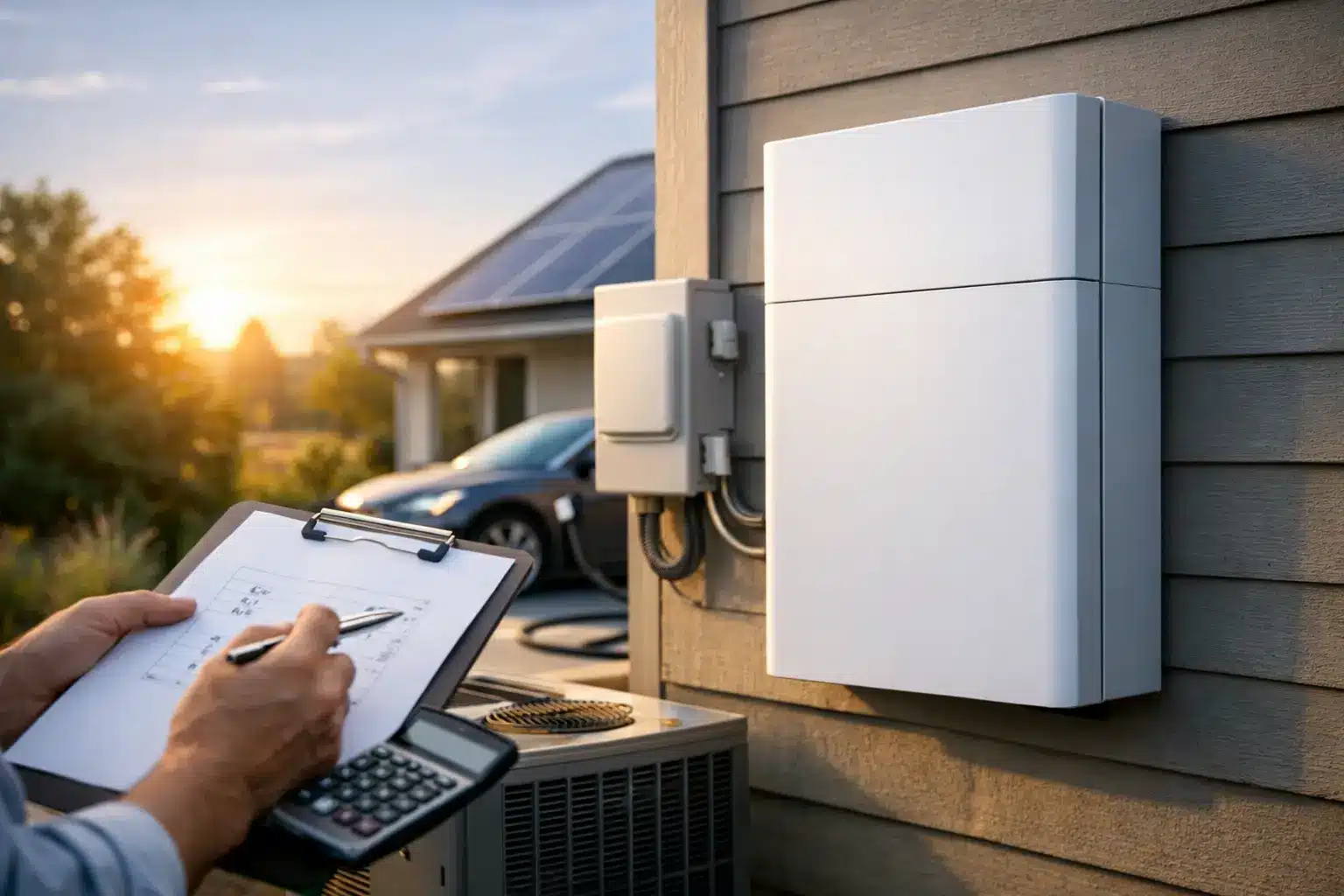
A home battery that is too small runs out just when you want it most. One that is too large can leave you paying for storage you rarely use. That is why learning how to size home battery properly matters before you compare quotes or choose an installer.
For most households, battery sizing is not about chasing the biggest unit on the market. It is about matching storage to the way you actually use electricity, when you use it, and what you want the battery to do. Some people want to store extra solar generation for the evening. Others want backup during power cuts. Some are trying to make the most of off-peak tariffs. The right size depends on those priorities.
How to size home battery for your property
The simplest place to start is your daily electricity use. If your home uses 10 kWh a day, that does not automatically mean you need a 10 kWh battery. What matters more is how much electricity you use after the sun goes down, because that is when battery storage usually does the heaviest lifting.
A household that uses most of its power in the evening could benefit from a larger battery than a home where people are out all day and use appliances while the solar panels are generating. In practical terms, many homes are trying to cover the late afternoon and evening period – cooking, lighting, television, internet routers and the general background demand that continues after solar production falls away.
If you already have smart meter data, look at half-hourly or hourly usage patterns. If not, recent electricity bills can still give you a useful starting point. The aim is to estimate your typical overnight or non-solar consumption, not just your total monthly use.
Start with what you want the battery to do
Battery storage can serve different jobs, and each one pushes the size in a slightly different direction.
If your main goal is to use more of your own solar power, you are usually looking to capture surplus generation during the day and use it later. In that case, the battery should be large enough to absorb your regular excess solar, but not so large that it sits half-empty for much of the year.
If your focus is reducing bills with time-of-use tariffs, a battery may be charged overnight at cheaper rates and used during expensive peak periods. Here, sizing often depends more on your evening demand than on your solar output.
If backup power is your priority, the question changes again. You need to decide what must stay on during an outage. Keeping the fridge, lights, broadband and a few sockets running is one thing. Covering electric heating, an immersion heater or a large induction hob is another. Full-house backup requires a very different setup from essential-load backup.
This is where many homeowners save money by being realistic. Most people do not need to run every appliance during a power cut. Choosing essential circuits only can reduce the battery size required and make the system more cost-effective.
Look at your solar generation, not just your electricity use
A battery can only store energy that is available to charge it. If you are pairing storage with solar panels, your panel output matters just as much as household demand.
For example, a home with a modest solar array may not regularly generate enough spare electricity to fill a large battery outside the sunnier months. In that situation, a smaller battery may give better value because it cycles more often. On the other hand, a larger solar system with frequent daytime export could justify more storage capacity.
Seasonality matters in the UK as well. A battery that works brilliantly in June may not fill fully in December. That does not mean it is the wrong size, but it does mean expectations should be grounded in year-round performance rather than peak summer conditions.
In places such as Cardiff, Newport or Bristol, installers will usually assess likely generation based on roof size, orientation, pitch and shading. That local detail matters because two homes with similar bills can have very different solar output.
Usable capacity matters more than headline capacity
Not all battery capacity is available for everyday use. Manufacturers often quote total capacity, but the more useful figure is usable capacity. This is the amount of stored electricity you can realistically draw from the battery.
As a simple example, a battery sold as 10 kWh might only offer 9 kWh of usable storage. The difference comes down to battery management and protection of long-term battery health. When comparing systems, always check usable capacity rather than assuming the headline number tells the whole story.
Power rating is a separate question
Capacity tells you how much energy a battery can store. Power rating tells you how much it can deliver at once. Both matter.
A battery may have enough stored energy to cover your evening use, but if its power output is too low, it might struggle to run several appliances at the same time. Kettle on, oven running, washing machine started – peak demand can rise quickly. If backup is important, power output becomes even more relevant.
This is one reason battery sizing should never be reduced to a single number. You are balancing storage capacity, discharge power, solar generation and household behaviour.
A practical way to estimate battery size
For a rough estimate, begin with your average evening and overnight use. Many households find this is somewhere between 4 kWh and 10 kWh, though it can be lower or higher depending on occupancy and heating type.
If you use around 6 kWh after solar production tails off, a battery with roughly 5 to 8 kWh of usable capacity may be a sensible range to explore. If your evening consumption is closer to 10 kWh, you may need something larger. But there is no prize for oversizing. If you rarely fill or discharge the battery properly, the economics can weaken.
Future changes matter too. If you are planning to add an EV charger, heat pump or electric hot water system, your electricity profile may look very different within a year or two. In that case, it can make sense to choose a modular battery system that can be expanded later rather than paying upfront for maximum capacity now.
The trade-off between savings and payback
A larger battery can increase self-consumption and cut imports from the grid, but bigger is not always better financially. As battery size increases, each extra kilowatt-hour of storage may deliver less value than the last.
That is because there comes a point where your battery is big enough for most of your regular needs. Beyond that, extra capacity may only be used occasionally. This can lengthen payback.
The sweet spot is often a battery that gets used frequently. Regular charging and discharging tends to deliver better value than a system sized for rare worst-case scenarios. A good installer should be willing to talk through that trade-off rather than simply recommending the largest unit available.
Common sizing mistakes to avoid
One common mistake is basing the battery purely on annual electricity use. Annual totals hide the timing of consumption, and timing is central to battery performance.
Another is ignoring export behaviour. If your solar system already exports a healthy surplus most days, a battery may make sense. If you already use nearly all your solar generation directly, the gains from storage may be smaller.
It is also easy to underestimate high-demand appliances. Homes with electric showers, electric heating or frequent tumble dryer use may need a different setup from homes heated by petrol. Equally, some households overestimate their backup needs and end up paying for capacity they are unlikely to use.
Finally, do not compare batteries on capacity alone. Warranty, cycle life, inverter compatibility and whether the system is AC-coupled or DC-coupled can all influence long-term value.
Why installer advice matters
Battery sizing looks simple from a distance, but the details can change the recommendation quickly. Your roof layout, tariff, solar array size, property wiring and future plans all shape the right answer.
That is where working with vetted, MCS-accredited installers can make the process much easier. Instead of relying on guesswork, you can get recommendations based on your actual property and energy use. For homeowners who want a quicker route to comparing options, Solar Planet helps connect you with trusted local installers so you can see how different systems stack up without the legwork of researching each company yourself.
So what size home battery do most people need?
There is no universal answer, but many UK homes with solar land somewhere in the small-to-mid range rather than the very largest systems. Often, the best choice is enough usable storage to cover a typical evening, with room to expand later if your needs change.
If you are wondering how to size home battery storage for your own property, the best next step is to look at real usage data and get tailored advice rather than relying on averages alone. A well-sized battery should feel practical, not excessive – helping you use more of your own energy, cut waste and make the numbers work with confidence.
The right battery size is the one that suits your home as it is now, while leaving sensible room for what comes next.

